


- With years of industry knowledge, we bring unparalleled expertise to every project.
- Our rigorous standards ensure top-notch quality in all our products.
- Constantly striving for new and improved solutions, we never stop innovating.
- Tailoring our services to your unique needs, we ensure complete satisfaction.
- Experience excellence with our dedicated support and customer-focused approach.
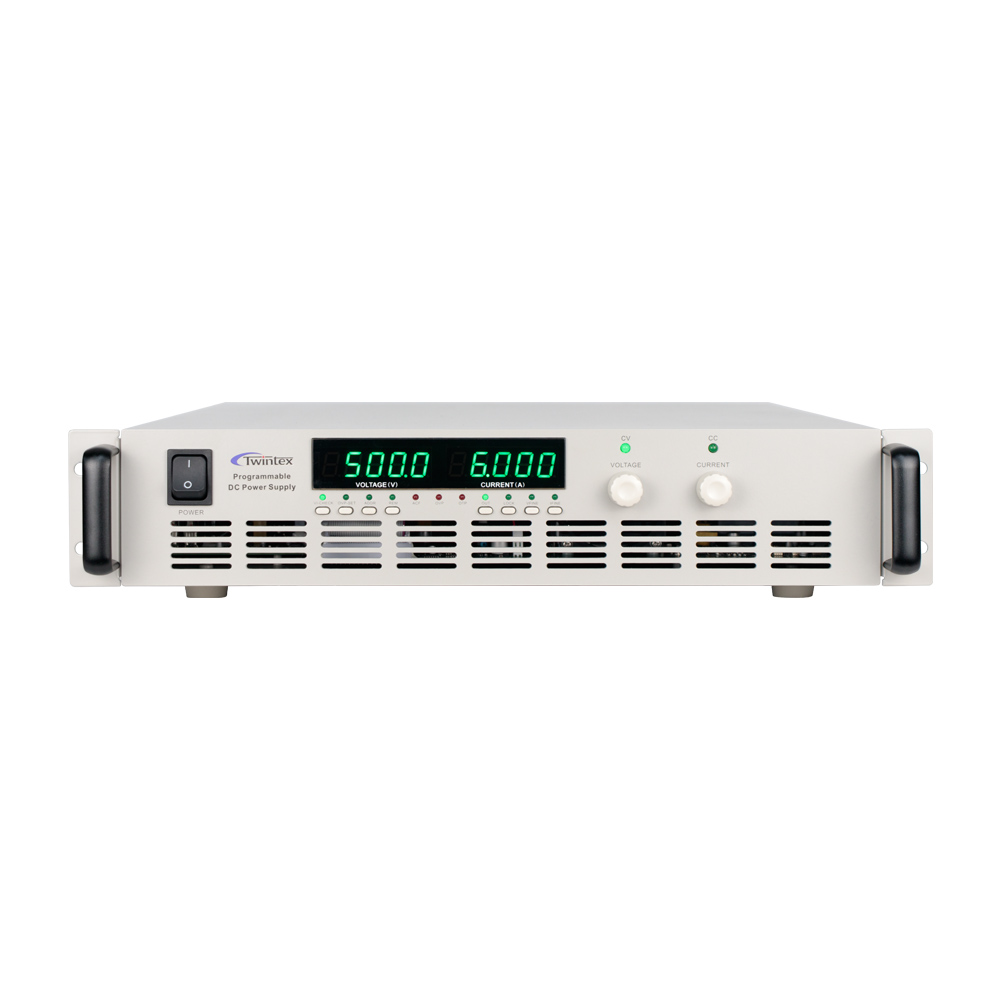
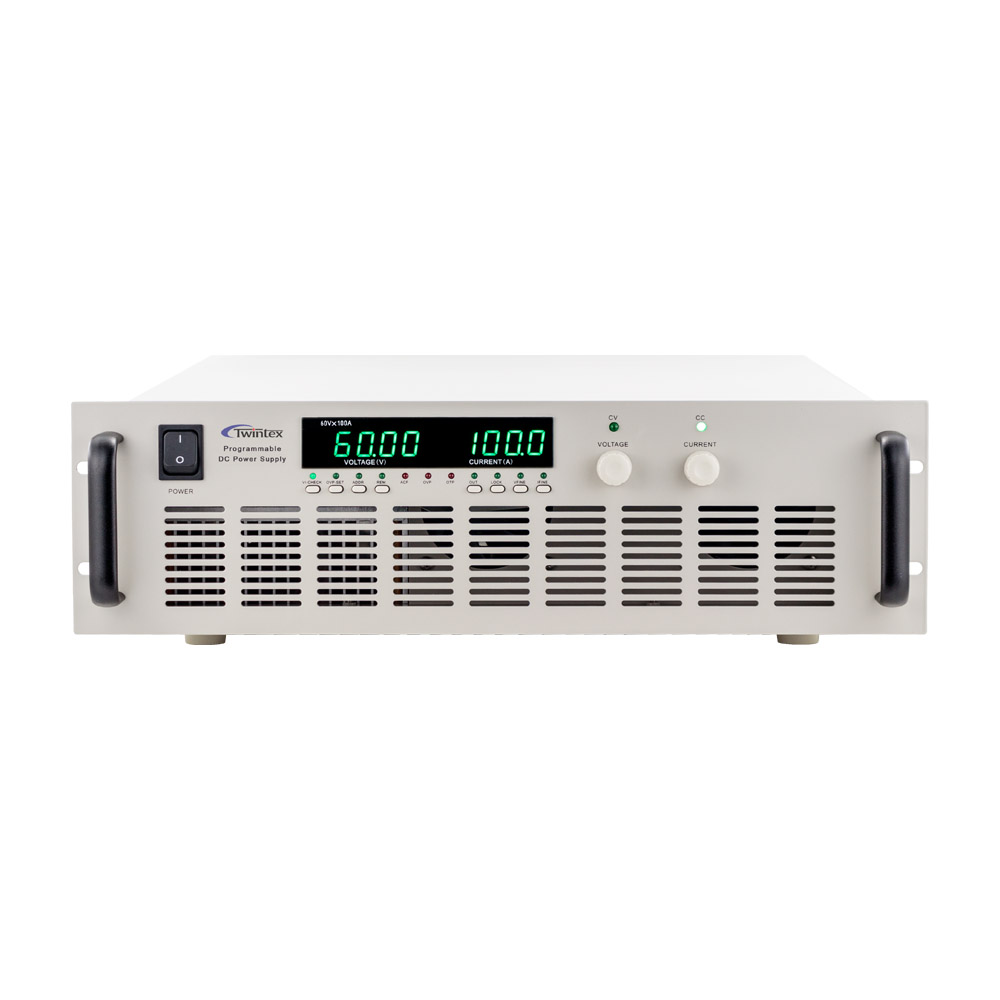
PCH 6000V 6kV 2A 3A 5A 10A 12A High Voltage DC Power Supply 10kW 15kW 30kW 45kW 60kW 75kW
PCH 6000V 6kV 2A 3A 5A 10A 12A High Voltage DC Power Supply 10kW 15kW 30kW 45kW 60kW 75kW
- PCH 6000V 6kV 2A 3A 5A 10A 12A High Voltage DC Power Supply
- Rated voltage 6000V (6kV)
- Negative polarity at requests
- Rated power 10kW 15kW 30kW 45kW 60kW 75kW
- Low ripple 0.2%FS rms
- List mode function
- Auto Run function
- Interlock loop function
- No overshoot during startup
- Soft start by hardware, and adjustable voltage rise time by software
- Constant voltage and constant current operations, auto CV/CC switch
- Multiple protections: OVP, OTP, ACF and current limit protections
- Standard interface: RS232 & RS485, support ModBus-RTU commands
- Options: DC 0-5V, 0-10V or 4mA interface for control and feedback
- Options: LAN interface
Quote Now
Twintex PCH 6000V (6kV) high voltage DC power supplies, rated at power levels of 10kW to 75kW, are primarily used for burn-in testing of industrial-grade or system-level devices that demand exceptional resilience against power and voltage stress. Unlike low-power testing of individual components, these applications focus on verifying the long-term reliability and stability of the entire system.
- Power semiconductor devices: This is a core application of PCH 6000V (6kV) high voltage DC power supplies. These power supplies can be integrated into burn-in testing systems of IGBTs, MOSFETs, and diodes, as well as emerging high-voltage, high-power devices such as Silicon Carbide (SiC) and Gallium Nitride (GaN) components. Testing involves applying rated (or higher) voltage and current combined with temperature & humidity control to evaluate performance degradation and lifespan under prolonged high-voltage, high-power operation.
- High-voltage capacitors: PCH 6000V (6kV) high voltage DC power supplies can be used for burn-in testing of high-voltage power capacitors, supercapacitors, and similar components. Long-duration charge-discharge cycles or continuous operation at rated high voltage are employed to assess capacitance degradation, changes in equivalent series resistance (ESR), and the long-term stability of insulation performance.
- Power and distribution equipment: PCH 6000V (6kV) high voltage DC power supplies can be used to verify the reliability of critical equipment within power systems. Such as long-term withstand-voltage burn-in tests for high-voltage cables, transformers, switchgear, instrument transformers, and insulators. Continuous application of high voltage simulates years of electric field stress experienced in the power grid, allowing for the evaluation of insulation aging rates and expected service life.
- Industrial and specialized electronic equipment: In specialized sectors, PCH 6000V (6kV) high voltage DC power supplies are used for burn-in testing of high-voltage electron tubes, gas discharge tubes, high-power variable frequency drives (VFDs), and avionics, ensuring reliability under rigorous operating conditions.
The PCH 6000V (6kV) high voltage DC power supplies typically operate in two modes during burn-in testing.
- Continuous energization burn-in: Applying rated (or slightly higher) voltage/current to the device under test (DUT) for an extended period to simulate the aging process under normal operating conditions.
- Cyclic stress burn-in: Simulating more rigorous operating conditions. Examples include high/low-temperature cycling or cyclic load testing, where the load or ambient temperature is periodically varied while high voltage is applied, thereby accelerating product aging.
Typical models:
PCH15K-60HN: -6000V 2.5A 15kW DC Power Supply, negative polarity
PCH30K-60H: 6000V 5A 30kW DC Power Supply, positive polarity
PCH60K-60H: 6000V 10A 60kW DC Power Supply, positive polarity
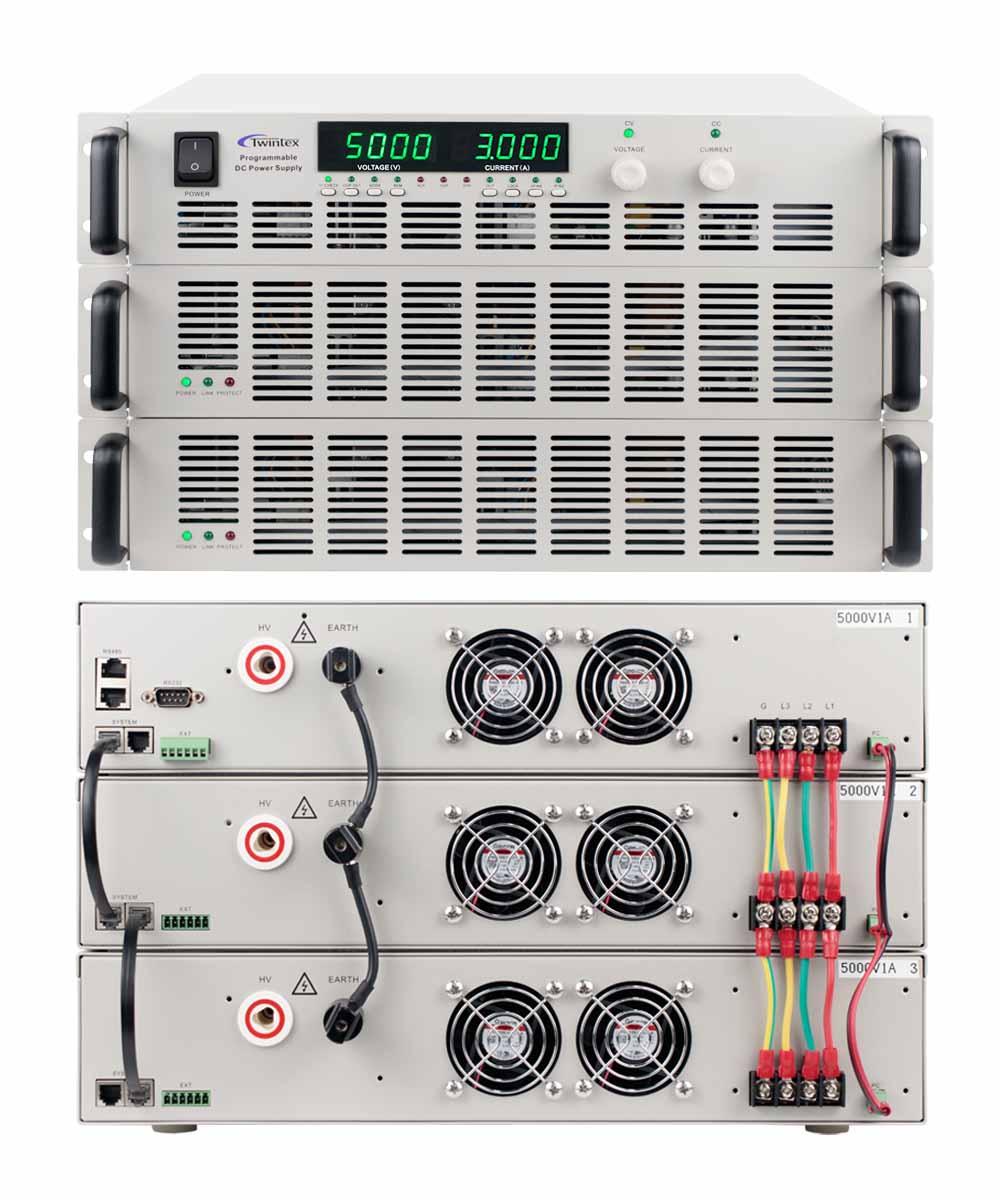
Product Parameters
PCH 6000V 6kV 2A 3A 5A 10A 12A High Voltage DC Power Supply 10kW 15kW 30kW 45kW 60kW 75kW
| Model | Rated Output | Model | Rated Output | |||||
| V | A | W | V | A | W | |||
| PCH10K-60H | 6000V | 0~1.667A | 10kW | PCH10K-60HN | -6000V | 0~1.667A | 10kW | |
| PCH15K-60H | 6000V | 0~2.5A | 15kW | PCH15K-60HN | -6000V | 0~2.5A | 15kW | |
| PCH20K-60H | 6000V | 0~3.333A | 20kW | PCH20K-60HN | -6000V | 0~3.333A | 20kW | |
| PCH25K-60H | 6000V | 0~4.167A | 25kW | PCH25K-60HN | -6000V | 0~4.167A | 25kW | |
| PCH30K-60H | 6000V | 0~5A | 30kW | PCH30K-60HN | -6000V | 0~5A | 30kW | |
| PCH35K-60H | 6000V | 0~5.833A | 35kW | PCH35K-60HN | -6000V | 0~5.833A | 35kW | |
| PCH40K-60H | 6000V | 0~6.667A | 40kW | PCH40K-60HN | -6000V | 0~6.667A | 40kW | |
| PCH45K-60H | 6000V | 0~7.5A | 45kW | PCH45K-60HN | -6000V | 0~7.5A | 45kW | |
| PCH50K-60H | 6000V | 0~8.333A | 50kW | PCH50K-60HN | -6000V | 0~8.333A | 50kW | |
| PCH60K-60H | 6000V | 0~10A | 60kW | PCH60K-60HN | -6000V | 0~10A | 60kW | |
| PCH65K-60H | 6000V | 0~10.833A | 65kW | PCH65K-60HN | -6000V | 0~10.83A | 65kW | |
| PCH70K-60H | 6000V | 0~11.67A | 70kW | PCH70K-60HN | -6000V | 0~11.67A | 70kW | |
| PCH75K-60H | 6000V | 0~12.5A | 75kW | PCH75K-60HN | -6000V | 0~12.5A | 75kW | |
| AC Input | 3φ4W (L1, L2, L3, PE), 380V±10% 47~63Hz (at default) 3φ4W (L1, L2, L3, PE), 415V/440V/480V±10% 47~63Hz (at request) | |||||||
For the purpose of product improvement, specifications are subject to change without prior notice.
Why Choose Us.
Frequently Asked Questions
A DC power supply is to supply voltage and current in constant voltage (CV) or constant current (CC) mode within the rated output range. Such working characteristics is called a constant voltage/constant current automatic cross-over type. This permits continuous transition from constant current to constant voltage modes in response to the load change. The intersection of constant voltage and constant current modes is called the crossover point. Below figure shows the relationship between this crossover point and the load.
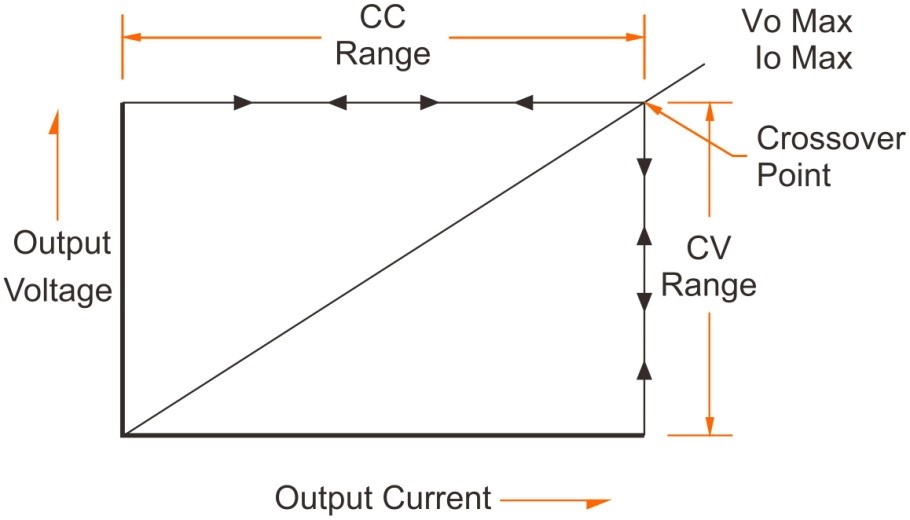
In CV mode, a regulated output voltage is provided. The output voltage remains constant as the load increases while the output current changes in response to the load changes, up till the present current limit point is reached. At that point, the output current becomes constant and the output voltage drops in proportion to the further increases in load.
Similarly, in CC mode, crossover from the CC to CV mode automatically occurs from a decrease in the load. A regulated output current is provided. The output current remains constant as the load decreases while the output voltage changes in response to the load changes.
A power supply with CV and CC operation mode can be operated in only one mode according to load situation. The power supply is in CV mode when the actual load is over the preset load capacity; and the power supply is in CC mode when the actual load is below the preset load capacity.
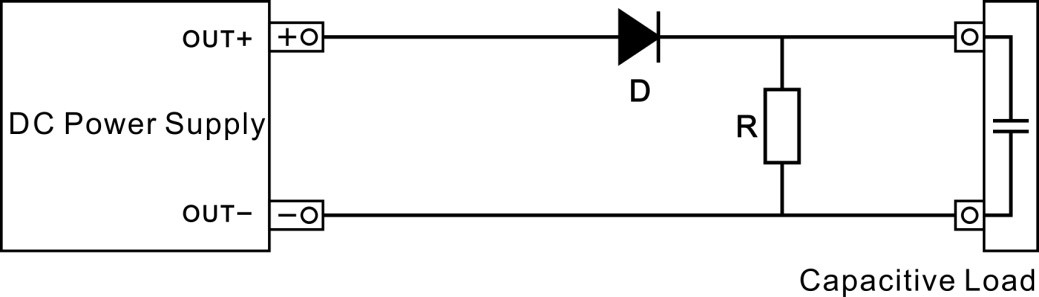
When the power supply is connected to a big capacitive load, it always causes increase to the output voltage in a power supply. The output voltage may make fast increase to the Over Voltage Protection point. It may also cause slow decrease when the output voltage is turned down.
To solve this problem, connect a power resistor in parallel to the output terminals of the power supply; at the same time, connect a diode in serial between output terminals and the load.
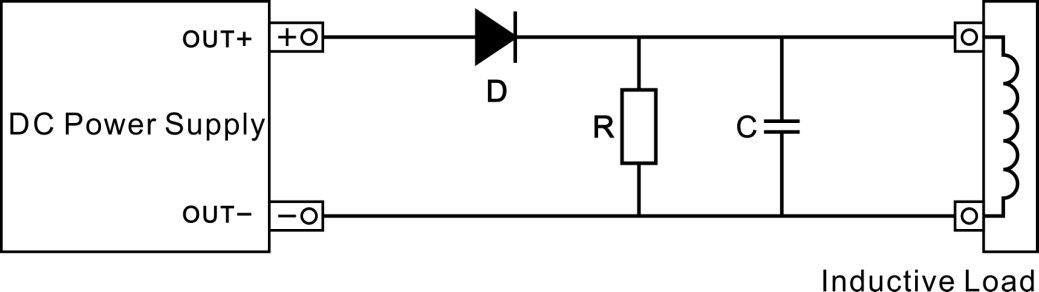
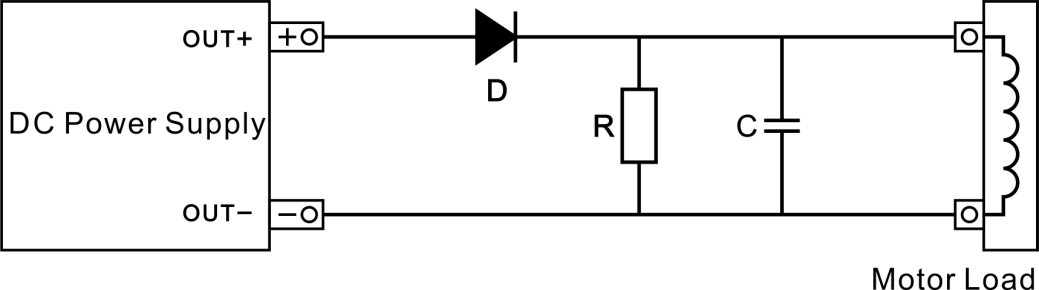
When an inductive load is connected to the power supply, it will cause a reverse polarity induction electric motive force when the power supply is turned on or off, or when preset the output voltage. The pulse noise caused by an inductive load will also affect the power supply, especially when the pulse noise has the same polarity with the output of power supply.
To avoid effect or damage to the power supply, connect a diode in serial between the output terminals of power supply and the load; at the same time, connect a power resistor and a capacitor in parallel to the load to make a R-C snubbed circuit, which will significantly restraint generation of the noise.
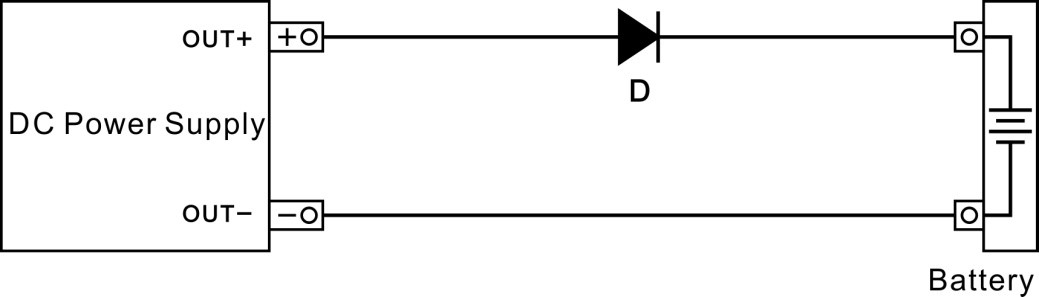
When use the power supply to charge a battery, such as accumulator and ni-mh battery, the recommended protection measures is to connect a diode between the power supply and the battery. When the output electrolytic capacitor of the power supply is charged, connecting a load (battery) may cause sparks. This is normal. After the two of them get to equal voltage, the sparks will disappear.
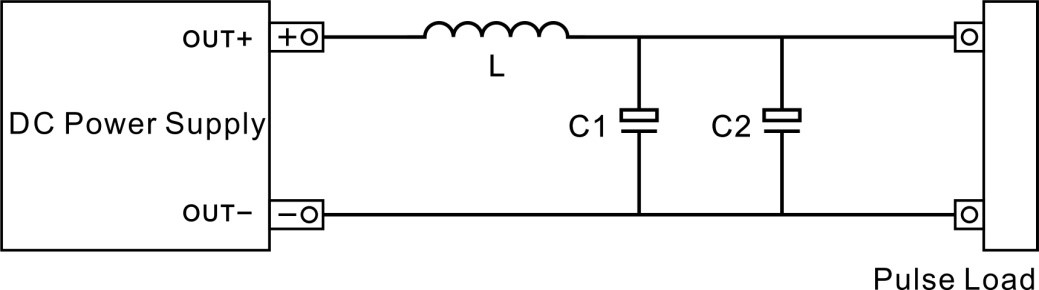
Even if the peak current of a pulse load, such as motor, bulb, DC-DC or DC-AC converter module, does not exceed the rated current of the power supply, it will also cause voltage drop or instability to the output.
A basic solution is to connect a inductor in serial between the power supply and the load. Or, choose a power supply with higher rated current.
If the pulse circuit has a small pulse width or low peak current, another solution is to connect a capacitor with large capacity. A reference to choose capacity of a capacity is: 1000uF capacity to a 1A current.
When the power supply is connected to a load that will cause reverse polarity current to the power supply output, the output voltage will increase, because the power supply cannot absorb the reverse polarity current from the load.
A solution is to connect a diode in serial between the output terminal and the load; at the same time, connect a discharge resistor in parallel to the load to absorb the reverse polarity current. When the reverse polarity current is a peak surge, connect the large electrolytic capacitor in parallel to the two ends of the load.
Get Quote Now!
Welcome to discuss your purchasing requirements with our customer service.
Get The
Catalogue
Document
From more than 10 years experiences in OEM & ODM services, our sales team and technical team are always available to check and discuss your requirement details.Whether you’re looking for reliable DC motors to enhance precision in your devices or powerful AC motors for robust industrial applications, we have you covered.

 English
 Español
 Français
 Português
 Русский